4K vs 1080p Viewing Distance: When You Can See It
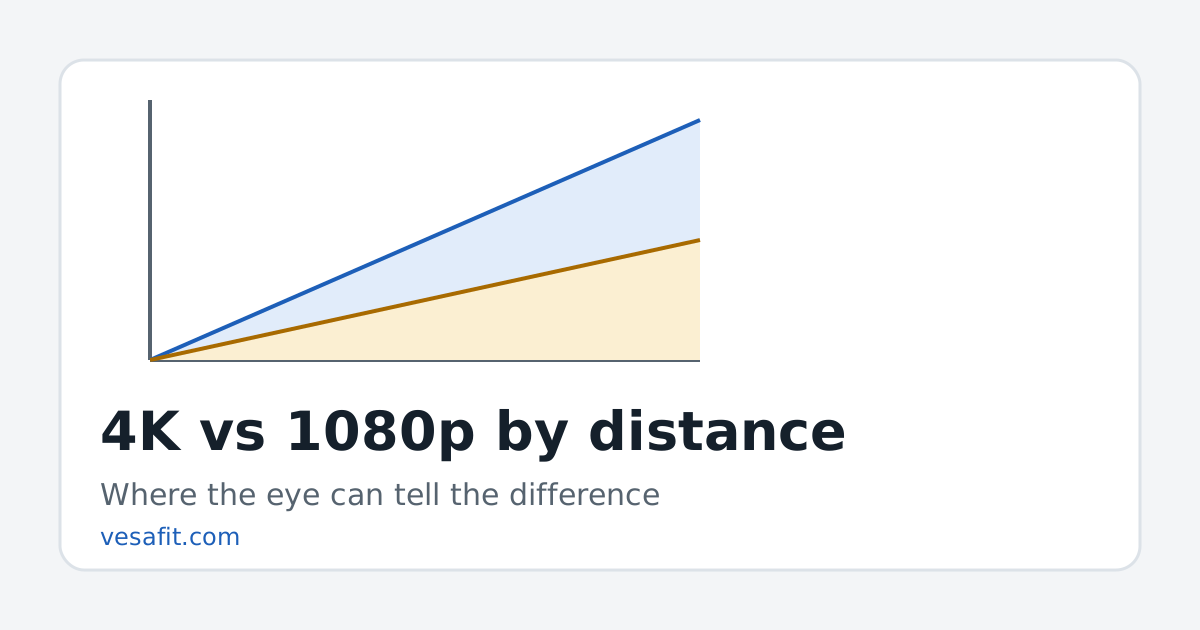
4K vs 1080p viewing distance comes down to one number: for 20/20 vision, 4K only looks sharper than 1080p when you sit closer than about 1.56 times the screen's diagonal. For a 65-inch TV that is 8 ft 5 in; for a 55-inch, 7 ft 2 in.
The limit of 20/20 vision
20/20 vision resolves detail down to about one arcminute — one sixtieth of a degree. Once a single pixel subtends less than that from where you sit, the eye can't separate it from its neighbours, and adding more pixels adds nothing you can see.
From that, the farthest distance at which a screen's pixels are still resolvable is:
distance = screen width ÷ (horizontal pixels × tan(1 arcminute))
For a 16:9 screen this gives about 1.56 × diagonal for 1080p and 0.78 × diagonal for 4K. Those are the same figures the source expresses as viewing angles: the screen must fill about 31.2° for 1080p's pixels to be resolvable, and about 58.37° for 4K's. The formula above reproduces both.
The table
| TV size | 1080p limit | 4K limit | SMPTE 30° seat | THX 40° seat |
|---|---|---|---|---|
| 43" | 5 ft 7 in | 2 ft 10 in | 5 ft 10 in | 4 ft 3 in |
| 55" | 7 ft 2 in | 3 ft 7 in | 7 ft 5 in | 5 ft 6 in |
| 65" | 8 ft 5 in | 4 ft 3 in | 8 ft 10 in | 6 ft 6 in |
| 75" | 9 ft 9 in | 4 ft 11 in | 10 ft 2 in | 7 ft 6 in |
| 85" | 11 ft 1 in | 5 ft 6 in | 11 ft 6 in | 8 ft 6 in |
Read across a row. Sit closer than the 1080p limit and 1080p's pixel structure is visible, so 4K looks sharper. Sit farther and 1080p already reaches the eye's limit. Sit closer than the 4K limit and even 4K's pixels are visible — only there would 8K help.
The pattern that falls out
Look at the last two columns. The SMPTE everyday seat (about 1.63 × diagonal) is always just beyond the 1080p limit (1.56 × diagonal); the THX cinema seat (1.2 × diagonal) is always well inside it. Because all of these distances scale with the diagonal, that holds at every size:
- At the everyday distance, 4K is barely distinguishable from 1080p.
- At the cinema distance, 4K is clearly sharper.
So the case for 4K resolution is really a case for sitting closer or buying bigger — which is exactly what the THX figure recommends.
Turned around: from your seat
If you know your distance, the question becomes how big the screen must be for 4K to pay off. From 8 feet it's about 62 inches; from 10 feet, about 77; from 12 feet, about 92. Each distance page gives the figure, and the size pages give it the other way round — for example the 65-inch page.
What this doesn't mean
It doesn't mean 4K TVs are a waste. Almost every TV sold now is 4K, and 4K sets bring HDR, wider colour and better processing, which are visible at any distance. It also doesn't account for upscaling, compression or the quality of the source — a well-mastered 1080p disc can look better than a heavily compressed 4K stream. The acuity limit answers one narrow question: whether the extra pixels themselves are visible from your seat.
And 8K
On a 65-inch screen, 20/20 eyes can only resolve individual 4K pixels within about 4 ft 3 in, and 8K pixels within about 2 ft 1 in. From a sofa, 8K's resolution can't be seen; its value, if any, lies elsewhere.
Know your seat and screen size and the 4K vs 1080p viewing distance question has a clear answer — closer than 1.56 times the diagonal, 4K shows.
Sources
- Wikipedia, Optimum HDTV viewing distance — the one-arcminute (20/20) acuity basis and the 31.2° (1080p) and 58.37° (4K) view angles, citing Sugawara et al., "Future Prospects of HDTV".
- All distances are computed from those figures for a 16:9 screen; see the methodology.
Questions
At what distance can you see the difference between 4K and 1080p?
For 20/20 vision, closer than about 1.56 times the screen diagonal. For a 65-inch TV that is 8 ft 5 in; sit farther away and 1080p already reaches the limit of what the eye can resolve.
So is 4K pointless at normal distances?
Not pointless, but its resolution advantage is small at the SMPTE everyday distance and clear at THX's cinema distance. 4K sets also bring HDR, newer processing and better streaming support, which matter regardless of distance.
Is 8K worth it?
Not for resolution from a sofa. On a 65-inch screen, 20/20 eyes resolve individual 4K pixels only within about 4 ft 3 in, and 8K pixels within about 2 ft.
What if my eyesight is better than 20/20?
The limits move further out in proportion. The tables here use the 20/20 standard of one arcminute per pixel, which is the usual reference.