What Size TV for My Room? Distance, Angle and the Math
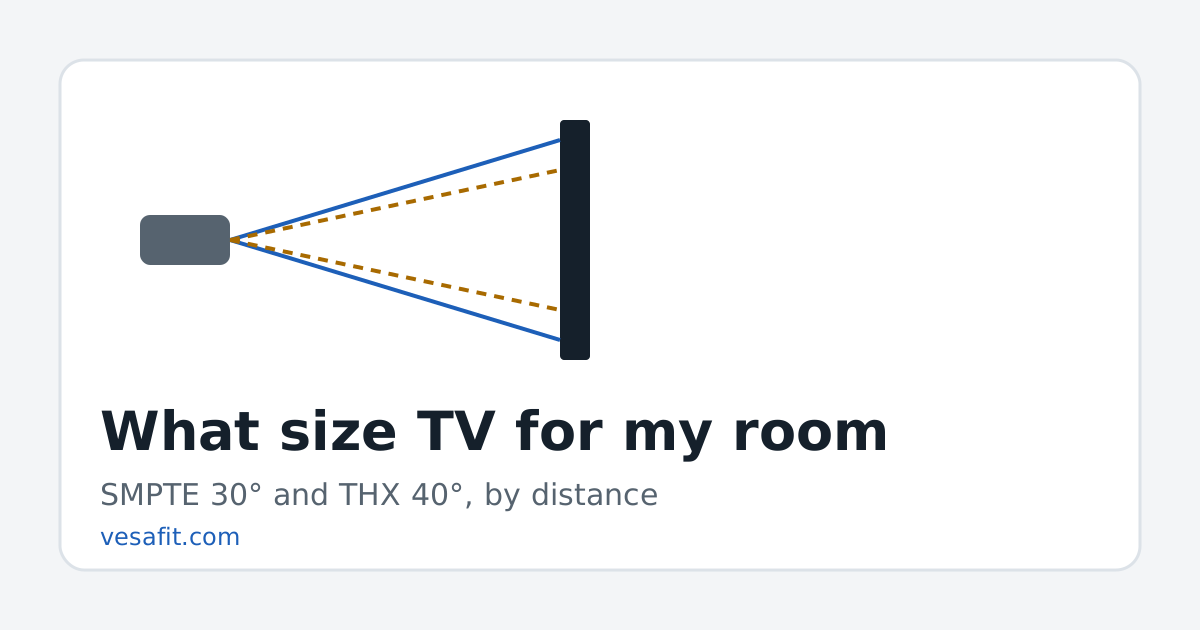
What size TV for your room depends on how far you sit and how much of your view you want the screen to fill: SMPTE's widely quoted 30° for everyday viewing, THX's 40° for film. At 8 feet that means roughly 59 to 80 inches; at 10 feet, 74 to 100.
The angle, not the size, is what you feel
A 65-inch TV looks huge at 6 feet and modest at 12. What stays constant is the angle the screen fills in your view. The two figures that come up again and again:
- 30° — widely quoted as the SMPTE recommendation for HDTV, and comfortable for news, sport and everyday viewing.
- 40° — THX's home-theater figure, more immersive, for films.
Turn those angles into a size with simple geometry. A 16:9 screen is 0.8716 times its diagonal wide. For the screen to fill an angle A from distance d, its width must be 2 × d × tan(A ÷ 2). Divide that by 0.8716 and you have the diagonal. The shortcut: diagonal ≈ distance ÷ 1.63 for 30°, distance ÷ 1.2 for 40° (both in inches).
Chart: size for distance
Computed with that formula; the last column is explained in the 4K guide.
| Seating distance | SMPTE 30° | THX 40° | 4K beats 1080p from |
|---|---|---|---|
| 6 ft | 44" | 60" | 46" |
| 8 ft | 59" | 80" | 62" |
| 9 ft | 66" | 90" | 69" |
| 10 ft | 74" | 100" | 77" |
| 12 ft | 89" | 120" | 92" |
Every distance from 4 to 16 feet has its own page, starting from the distance chart, and the calculator takes any distance.
Worked examples
8-foot living room. 96 inches ÷ 1.63 ≈ 59 inches; 96 ÷ 1.2 ≈ 80. A 55-inch TV fills 28° from 8 feet — a little small; a 65-inch fills 33°; a 75-inch fills 38°. Any of the last two is a good choice; the 75 for a room built around films.
10-foot great room. 120 ÷ 1.63 ≈ 74 inches; 120 ÷ 1.2 ≈ 100. This is where a 65-inch set, often bought as "the big one", turns out to be under the everyday figure, and 75 to 85 inches is the comfortable range.
6-foot bedroom. 72 ÷ 1.63 ≈ 44 inches; 72 ÷ 1.2 ≈ 60. A 43- to 55-inch set on the dresser fits the range; going larger works only if the wall allows it.
Or start from the TV size
| TV size | Screen width | Sit at (SMPTE 30°) | Sit at (THX 40°) |
|---|---|---|---|
| 43" | 37.5 in | 5 ft 10 in | 4 ft 3 in |
| 55" | 47.9 in | 7 ft 5 in | 5 ft 6 in |
| 65" | 56.7 in | 8 ft 10 in | 6 ft 6 in |
| 75" | 65.4 in | 10 ft 2 in | 7 ft 6 in |
| 85" | 74.1 in | 11 ft 6 in | 8 ft 6 in |
Each size has its own page with dimensions and the mount patterns in use — for example the 65-inch and 75-inch pages.
Things the math doesn't know
- The wall. A 75-inch screen is 65.4 inches wide before its bezel. Measure the wall between windows, doors and speakers.
- Several seats. Use the main seat for the calculation, then check the farthest one; if it's much further, lean toward the larger figure.
- Light. In a bright room a big screen is a big black rectangle when it's off, and a tilting mount helps with glare more than extra inches.
- Height. Put the centre of the screen near your seated eye height. A screen mounted high feels bigger and less comfortable than its angle suggests.
Measure from your eyes to the screen, divide by 1.6 and by 1.2, and you have the answer to what size TV for your room — then pick within that range for the way you watch.
Sources
- Wikipedia, Optimum HDTV viewing distance — the 30° (SMPTE) and 40° (THX) figures and THX's divide-by-0.84 rule; the article states 30° works out to 1.6264 times the diagonal, which the formula above reproduces.
- All other figures are computed from those angles for a 16:9 screen; see the methodology.
Questions
What size TV for 8 feet away?
About 59 inches by the SMPTE 30-degree figure and about 80 inches by THX's 40 degrees, so a 65- or 75-inch set sits comfortably in the range.
Is there a simple rule of thumb?
Divide your seating distance in inches by about 1.6 for everyday viewing, or by 1.2 for a cinema-style view. Both come from the viewing angles, not guesswork.
Is bigger always better?
No. Past about 40 degrees most people start turning their heads to follow the action, and in a bright room a very large screen dominates when it is off. The two standards bracket a sensible range.
Should I measure to the wall or the screen?
To the screen, from your eyes. A TV on a stand sits several inches in front of the wall and a full-motion mount can bring it further forward.